

American Aviation History: The Wright Flight
1903
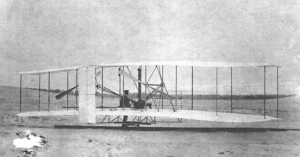
When Orville Wright and Wilbur Wright launched their Flyer at Kitty Hawk, the first powered flight lasted just 12 seconds and traveled only 120 feet, which is shorter than the wingspan of many modern business aircraft.
The brothers weren’t engineers. In fact, they were the only members of the Wright family who did not attend college. Instead, they ran a bicycle sales and repair shop.
In 1908, the Wrights signed a contract with the US Army for delivering a machine capable of flying for at least one hour with an average speed of 40 miles per hour. They completed the mission in 1909 and received a bonus for creating something that exceeded 40 miles per hour.
Interesting Fact: There were only 66 years between the Wright Brothers’ first flight to the landing on the moon!
American Aviation History: Flying mail
1918
The launch of America’s first scheduled airmail service was in 1918 between Washington D.C, and New York City, using War Department planes and pilots.
Air mail proved that aircraft could move information and commerce faster than ever before, reducing delivery times from weeks to days.
Interesting Fact: Early pilots flew without radios, GPS, weather radar, or modern navigation systems. Many followed railroad tracks and roads below.
American Aviation History: single pilot. Single engine. One ocean.
1927
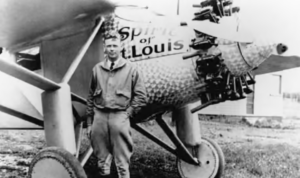
In 1927, 25-year-old Charles Lindbergh departed New York aboard the Spirit of St. Louis and flew nonstop to Paris.
The journey covered more than 3,600 miles and lasted 33½ hours. To carry enough fuel, the aircraft didn’t even have a traditional forward windshield. Lindbergh navigated using side windows and a periscope.
His accomplishment captured the world’s imagination and sparked a surge in aviation interest around the globe.
Interesting Fact: The production of aircraft nearly quadrupled in the years following Lindbergh’s flight. He showed what was possible.
American Aviation History: Jet off into the sunset
1950’s
By the 1950s, jet-powered aircraft were transforming aviation. Military technology developed during World War II found its way into commercial service, allowing aircraft to fly higher, faster, and farther than ever before.
In 1958, Boeing 707 entered commercial service and helped usher in the Jet Age, shrinking the world and making international travel more accessible. What once took days could now be accomplished in hours.
This changed how businesses operated, how families traveled, and how the world was connected.
Interesting Fact: In 1958, a round-trip economy ticket from New York to Paris would cost around $272. With inflation, the price today would be around $3,000.
American Aviation History: The Moon Walk
1969
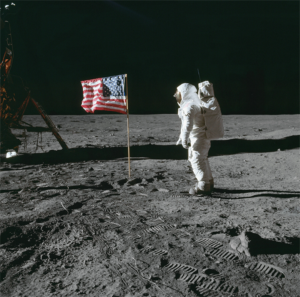
In 1961, John F. Kennedy set the national objective to land on the moon. Eight years later, the crew of Apollo 11 did just that.
The computers that guided the 239,000-mile mission had less processing power than smartphones today (64 KB of memory). Yet they helped achieve one of humanity’s greatest accomplishments.
Interesting Fact: Saturn V, the rocket used for the mission, generated about 7.5 million pounds of thrust during takeoff. A fully loaded Pilatus PC-12 weighs about 10,500 pounds, meaning the rocket generated enough thrust to lift the equivalent of more than 700 PC-12s at once.
American Aviation History: The Land of the PC-12
Today
The Pilatus PC-12 wasn’t crafted in America, but Americans certainly adopted it.
Today, nearly 80% of the world’s PC-12 fleet operates in North America. The PC-12 reflects something Americans have always valued: freedom and practicality.
Freedom to leave when you want.Freedom to land where the airlines can’t.
Freedom to bring your family, your business partners, your golf clubs, your dogs, or all of the above.
250 years of freedom. 120 years of flight. Here’s to what comes next!